The Art & The Style
Understanding the Art
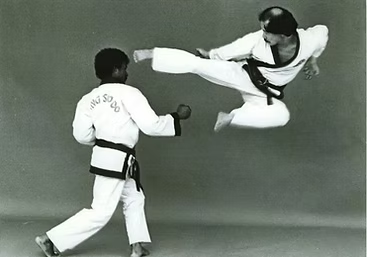
First, it is important to understand that Soo Bahk Do is the Art and Moo Duk Kwan is the Style. Soo Bahk Do is the technical side, and the Moo Duk Kwan is the philosophical side of “Soo Bahk Do Moo Duk Kwan.”
The name “Bahk” originated in the age of Chun Chu (2,700 years ago) according to the Moo Yei Dobo Tong Ji, which is one of the oldest records of Korea’s martial arts.
Soo Bahk Do (combat with bare hands and feet) is the only Korean martial art handed down from the Ko Ku Ryo Dynasty, thereby making it the oldest Korean martial art - approximately 2,000 years old.
Translated literally, Moo Duk Kwan means “Institute of Martial Virtue.” It is the scientific use of the body in methods of self-defense, combined with a strict philosophy guiding the practitioner towards discovering their full potential.
Soo Bahk Do, translated means “Hand Striking Way”, or the more esoteric translation: “Cultivation of the Individual” and is the means to forge a body towards gaining ultimate use of its faculties through intensive physical and mental training.
It is an art of self-defense and philosophy the secrets of which cannot be bought at any price other than serious and rigorous training. It is an art tempered on the lawns of Buddhist monasteries, against the steel of wandering bandits and on the fields of combat - its history is a long and honorable one.
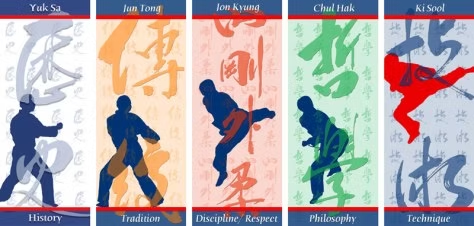
Philosophy
Many styles teach effective self-defense and fighting principles but Soo Bahk Do offers much more than just that. Learning fighting techniques without a strong philosophy is to burden society with more dangerous people.
We use Soo Bahk Do to realize our full potential and emphasize “Virtue in Action” - demonstrating courage, discipline, confidence and humility through our sincere efforts in training and our behavior towards others.
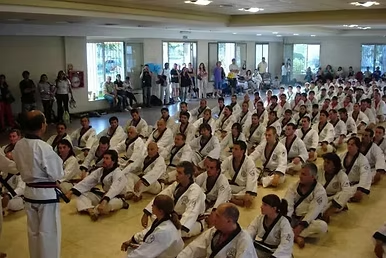
You won’t just hear our philosophy, you’ll see it in action. THIS is what makes Soo Bahk Do VERY DIFFERENT!
Authenticity Matters
If one looks at how “business” and the “Art” of Soo Bahk Do Moo Duk Kwan weigh in, for us, the Art is still more important. Many “Americanized” styles have no system. They have no roots back to founding masters, nor to ancient origins. Their uniforms and belts are random color-combinations to add glitz and flash.
On the contrary, our team emphasizes the journey, not the resulting “Black Belt” rank. We emphasize character, not flashy technique. We provide structure and excellence in instruction (along with corresponding books and videos) that have been passed on from generation to generation since ancient times.
Along with a single-style white uniform, we only carry the traditional belt colors of the seasons as we progress through the training stages.
Even what is known as the “Black” belt is in reality a “Midnight Blue” belt in our style, to symbolize the idea of never quite reaching perfection (the color black). At “Midnight Blue” the white uniform, or Do Bok, adds a midnight blue trim to represent the traditional, formal outfit of the warriors of the Ko Ku Ryo Dynasty.
Our promotion to Master (red stripe inside midnight blue belt) involves a rigorous eight-day boot camp, where character and poise under stress and sleep deprivation count just as much as effective technique.
Our Roots
In Korea, the indigenous arts of self-defense (Soo Bahk Ki and Tae Kyun) were combined with other fighting principles (Northern and Southern Chinese Kung Fu) and moral guidelines such as the philosophy of Do (Tao), No Ja (Lao Tzu) and Kong Ja (Confucius) by Founder Grandmaster Hwang Kee.
At a traditional festival called “Dan O,” seven-year-old Hwang Kee witnessed a lone man defending himself against a group of attackers using only his feet. This moment inspired his lifelong pursuit of martial arts.
At age 22, already recognized as a Master among martial artists, Hwang Kee began working for the Korean railroad company, which allowed him to travel extensively.
Hwang Kee met Chinese Kung Fu master Yang, Kuk Jin. Training consisted of Seh Bop (postures), Bo Bop (steps), Ryun Bop (conditioning) and Hyung (Forms) with their applications.
On November 9th, Grandmaster Hwang Kee founded the Moo Duk Kwan. The basic ideal: strong individuals in spirit and body make strong communities, strong communities make strong nations, strong and peaceful nations make a strong and peaceful world.
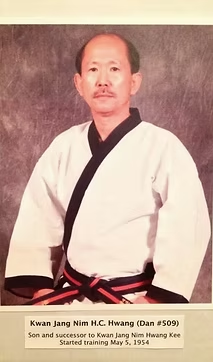
The Founder’s son H.C. Hwang began serving as Kwan Jang Nim (Grand Master). He embodies the dreams and aspirations of his father as Soo Bahk Do Moo Duk Kwan continues to flourish around the world.
Soo Bahk Do Moo Duk Kwan continues to grow worldwide, carrying on the legacy of the original martial art and the Founder’s interpretation of the Moo Yei Dobo Tong Gi.